
A speech by Capellaro
The memories of the people who worked at Teresio’s side.
The clippings
Click the images for the full document.
 Click for the full pdf document
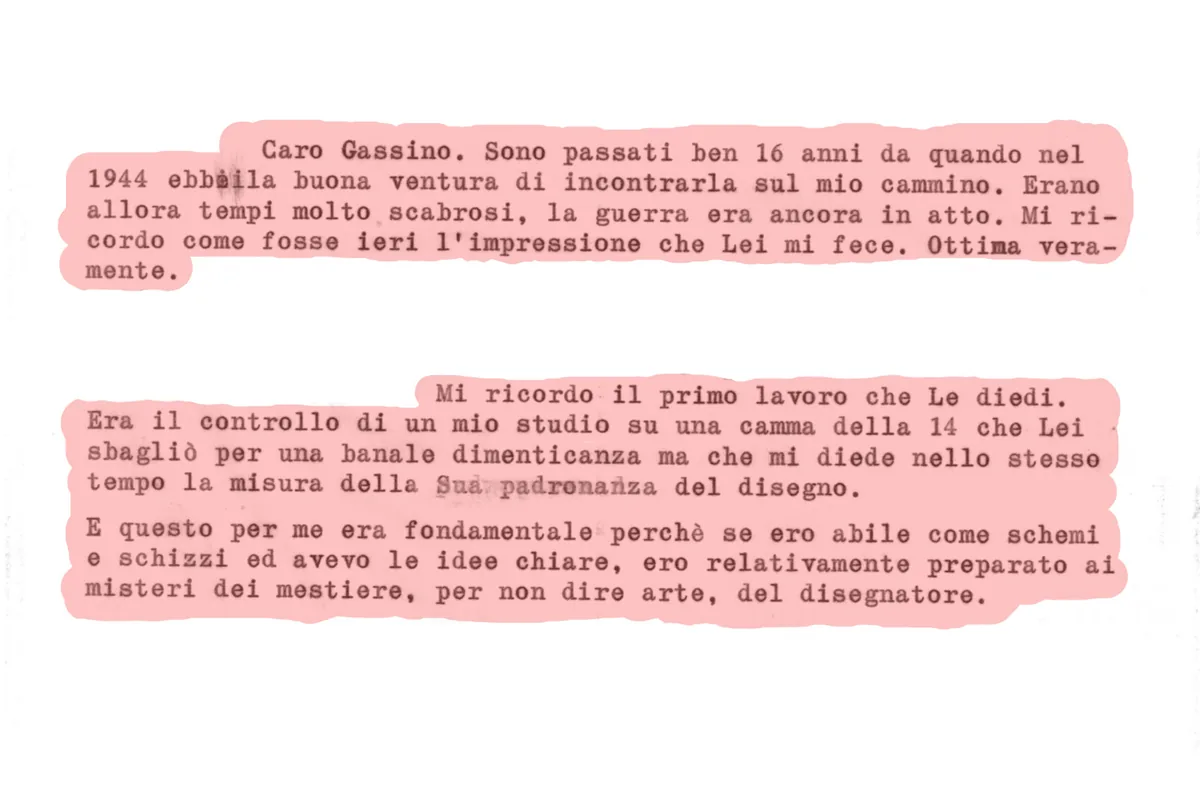
Reference colour: red, the same as the highlighted word in the first source paragraph at the bottom of the page. Transcript of the document, translated from the original Italian: “Dear Gassino. It has been sixteen years since, in 1944, I had the good fortune to cross paths with you. Those were very difficult times, the war was still under way. I remember, as if it were yesterday, the impression you made on me. A truly excellent one. I remember the first job I gave you. It was checking a study of mine on a cam for the 14, which you got wrong through a simple oversight, but which at the same time showed me the measure of your mastery of drawing. And this was fundamental for me, because while I was skilled at diagrams and sketches and had clear ideas, I was relatively unprepared for the mysteries—or rather, the art—of the draughtsman’s trade.”
Click for the full pdf document
Reference colour: red, the same as the highlighted word in the first source paragraph at the bottom of the page. Transcript of the document, translated from the original Italian: “Dear Gassino. It has been sixteen years since, in 1944, I had the good fortune to cross paths with you. Those were very difficult times, the war was still under way. I remember, as if it were yesterday, the impression you made on me. A truly excellent one. I remember the first job I gave you. It was checking a study of mine on a cam for the 14, which you got wrong through a simple oversight, but which at the same time showed me the measure of your mastery of drawing. And this was fundamental for me, because while I was skilled at diagrams and sketches and had clear ideas, I was relatively unprepared for the mysteries—or rather, the art—of the draughtsman’s trade.”
 Click for the full pdf document
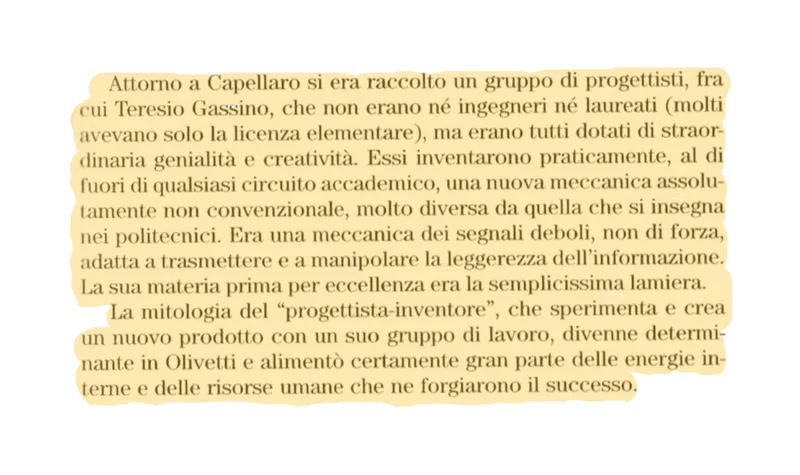
Reference colour: yellow, the same as the highlighted word in the second source paragraph at the bottom of the page. Transcript of the page, translated from the original Italian: “Around Capellaro a group of designers had gathered, Teresio Gassino among them, who were neither engineers nor graduates (many had only an elementary-school certificate), but were all endowed with extraordinary genius and creativity. Working entirely outside any academic circuit, they practically invented a wholly unconventional new mechanics, very different from what was taught in the polytechnics. It was a mechanics of weak signals, not of force, suited to transmitting and manipulating the lightness of information. Its raw material par excellence was the simplest sheet metal. The mythology of the ‘designer-inventor,’ who experiments and creates a new product with his own working group, became decisive at Olivetti and certainly fuelled much of the internal energy and human resources that forged its success.”
Click for the full pdf document
Reference colour: yellow, the same as the highlighted word in the second source paragraph at the bottom of the page. Transcript of the page, translated from the original Italian: “Around Capellaro a group of designers had gathered, Teresio Gassino among them, who were neither engineers nor graduates (many had only an elementary-school certificate), but were all endowed with extraordinary genius and creativity. Working entirely outside any academic circuit, they practically invented a wholly unconventional new mechanics, very different from what was taught in the polytechnics. It was a mechanics of weak signals, not of force, suited to transmitting and manipulating the lightness of information. Its raw material par excellence was the simplest sheet metal. The mythology of the ‘designer-inventor,’ who experiments and creates a new product with his own working group, became decisive at Olivetti and certainly fuelled much of the internal energy and human resources that forged its success.”
 Click for the full pdf document
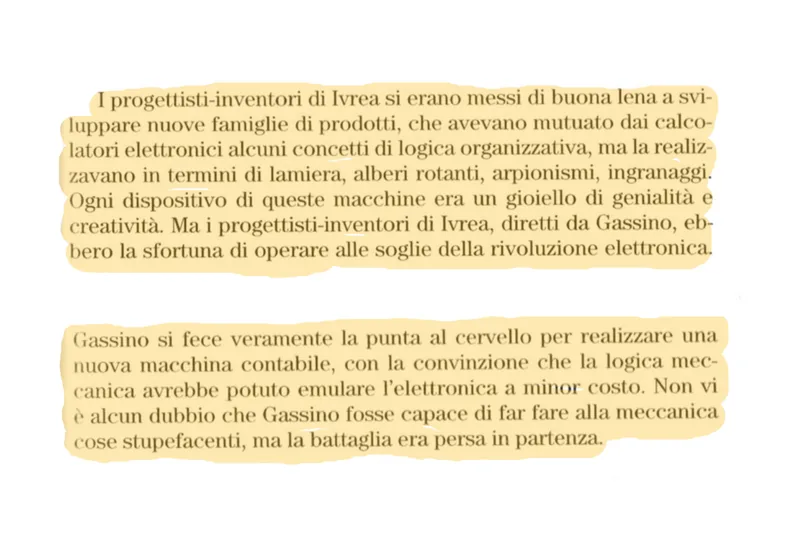
Reference colour: yellow, the same as the highlighted word in the second source paragraph at the bottom of the page. Transcript of the page, translated from the original Italian: “The designer-inventors of Ivrea had set to work with a will to develop new families of products, borrowing certain concepts of organisational logic from electronic calculators, but realising them in terms of sheet metal, rotating shafts, ratchet mechanisms, gears. Every device in these machines was a jewel of genius and creativity. But the designer-inventors of Ivrea, led by Gassino, had the misfortune of working right on the threshold of the electronic revolution. Gassino truly racked his brains to build a new accounting machine, convinced that mechanical logic could emulate electronics at a lower cost. There is no doubt that Gassino was capable of making mechanics do astonishing things, but the battle was lost from the start.”
Click for the full pdf document
Reference colour: yellow, the same as the highlighted word in the second source paragraph at the bottom of the page. Transcript of the page, translated from the original Italian: “The designer-inventors of Ivrea had set to work with a will to develop new families of products, borrowing certain concepts of organisational logic from electronic calculators, but realising them in terms of sheet metal, rotating shafts, ratchet mechanisms, gears. Every device in these machines was a jewel of genius and creativity. But the designer-inventors of Ivrea, led by Gassino, had the misfortune of working right on the threshold of the electronic revolution. Gassino truly racked his brains to build a new accounting machine, convinced that mechanical logic could emulate electronics at a lower cost. There is no doubt that Gassino was capable of making mechanics do astonishing things, but the battle was lost from the start.”
 Click for the full pdf document
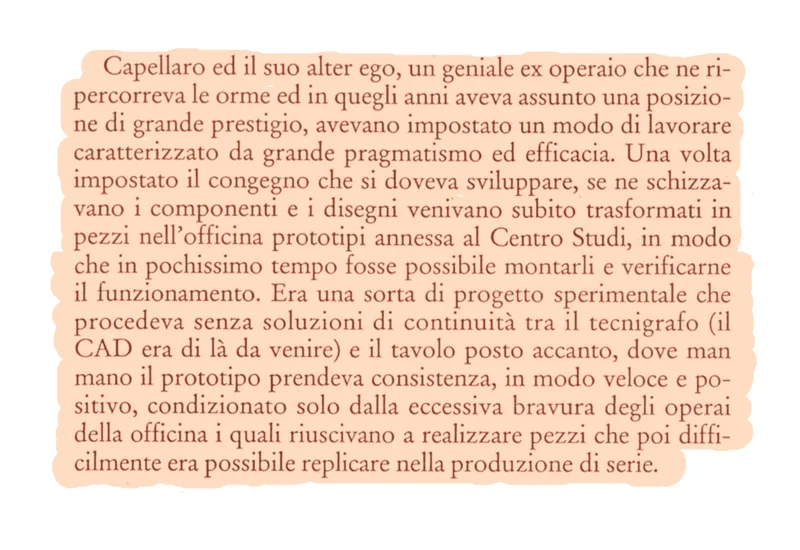
Reference colour: peach, the same as the highlighted word in the third source paragraph at the bottom of the page. Transcript of the page, translated from the original Italian: “Capellaro and his alter ego—a brilliant former factory worker who followed in his footsteps and had by then risen to a position of great prestige—had established a way of working marked by great pragmatism and effectiveness. Once the device to be developed had been defined, its components were sketched out and the drawings were immediately turned into parts in the prototype workshop attached to the Centro Studi, so that in a very short time it was possible to assemble them and test how they worked. It was a kind of experimental project that proceeded without any break in continuity between the drawing board (CAD was still a long way off) and the workbench next to it, where the prototype gradually took shape, quickly and successfully—limited only by the sheer skill of the workshop’s workers, who managed to produce parts that later proved difficult to replicate in series production.”
Click for the full pdf document
Reference colour: peach, the same as the highlighted word in the third source paragraph at the bottom of the page. Transcript of the page, translated from the original Italian: “Capellaro and his alter ego—a brilliant former factory worker who followed in his footsteps and had by then risen to a position of great prestige—had established a way of working marked by great pragmatism and effectiveness. Once the device to be developed had been defined, its components were sketched out and the drawings were immediately turned into parts in the prototype workshop attached to the Centro Studi, so that in a very short time it was possible to assemble them and test how they worked. It was a kind of experimental project that proceeded without any break in continuity between the drawing board (CAD was still a long way off) and the workbench next to it, where the prototype gradually took shape, quickly and successfully—limited only by the sheer skill of the workshop’s workers, who managed to produce parts that later proved difficult to replicate in series production.”
 Click for the full document
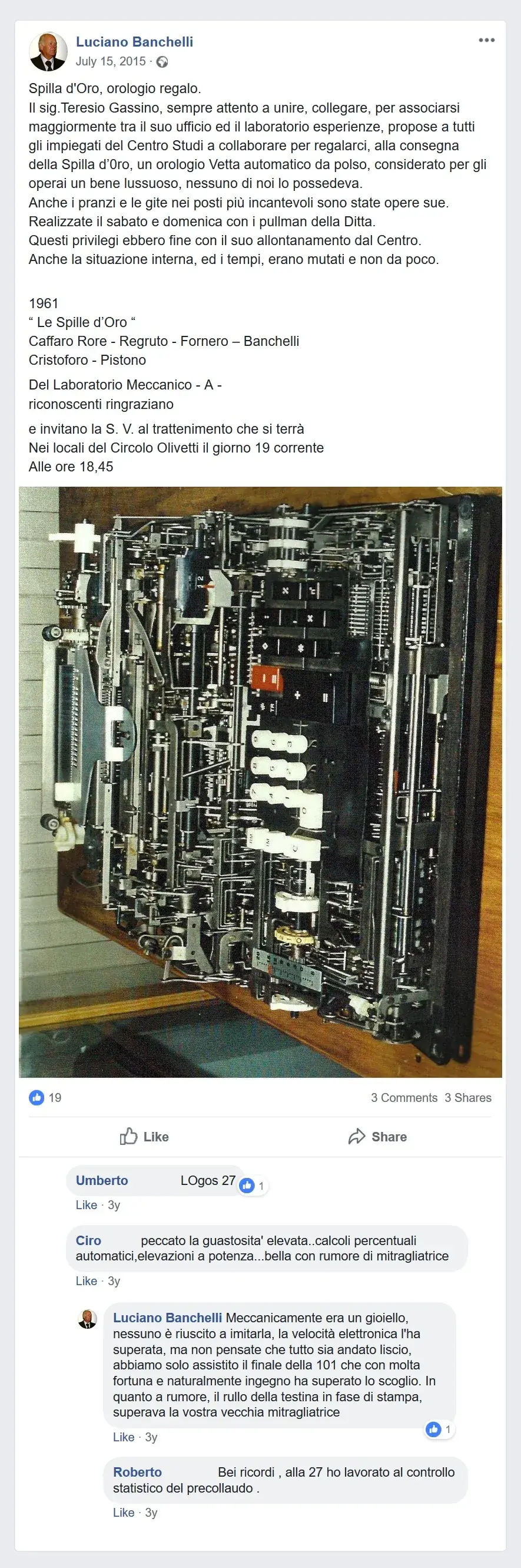
Reference colour: blue, the same as the highlighted word in the fourth source paragraph at the bottom of the page. Transcript of the post, translated from the original Italian: “Spilla d’Oro (‘Golden Pin’), gift watch. Mr. Teresio Gassino, always keen to bring people together, to connect his own office more closely with the experimental lab, suggested to all the Centro Studi white-collar staff that they club together to give us, on the occasion of the Spilla d’Oro award, an automatic Vetta wristwatch—something we workers considered a real luxury; none of us owned one. He also organised the lunches and outings to the most delightful places, held on Saturdays and Sundays using the Company’s own coaches. These perks came to an end when he left the Centro. The internal situation, and the times themselves, had also changed, and considerably so.”
Click for the full document
Reference colour: blue, the same as the highlighted word in the fourth source paragraph at the bottom of the page. Transcript of the post, translated from the original Italian: “Spilla d’Oro (‘Golden Pin’), gift watch. Mr. Teresio Gassino, always keen to bring people together, to connect his own office more closely with the experimental lab, suggested to all the Centro Studi white-collar staff that they club together to give us, on the occasion of the Spilla d’Oro award, an automatic Vetta wristwatch—something we workers considered a real luxury; none of us owned one. He also organised the lunches and outings to the most delightful places, held on Saturdays and Sundays using the Company’s own coaches. These perks came to an end when he left the Centro. The internal situation, and the times themselves, had also changed, and considerably so.”
 Click for the full document
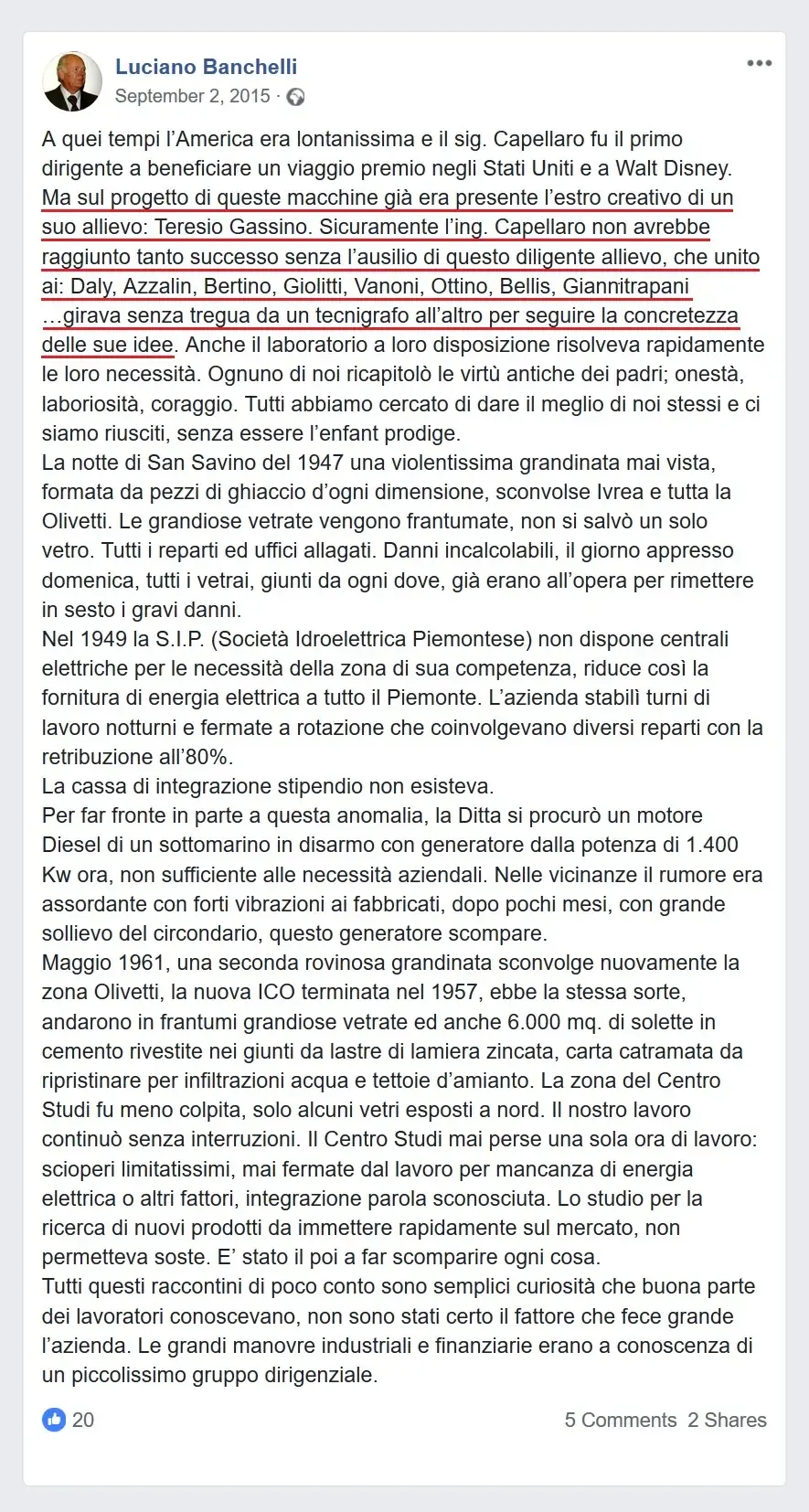
Reference colour: blue, the same as the highlighted word in the fourth source paragraph at the bottom of the page. Transcript of the post, translated from the original Italian: “In those days America was very far away, and Mr. Capellaro was the first manager to be given a reward trip to the United States and to Walt Disney. But already present in the design of these machines was the creative spark of one of his pupils: Teresio Gassino. Engineer Capellaro would certainly not have achieved such success without the help of this diligent pupil, who—together with Daly, Azzalin, Bertino, Giolitti, Vanoni, Ottino, Bellis, Giannitrapani …moved tirelessly from one drawing board to another to keep pace with his ideas as they took shape. The lab available to them also met their needs quickly. Each of us embodied the old virtues of our fathers: honesty, hard work, courage.”
Click for the full document
Reference colour: blue, the same as the highlighted word in the fourth source paragraph at the bottom of the page. Transcript of the post, translated from the original Italian: “In those days America was very far away, and Mr. Capellaro was the first manager to be given a reward trip to the United States and to Walt Disney. But already present in the design of these machines was the creative spark of one of his pupils: Teresio Gassino. Engineer Capellaro would certainly not have achieved such success without the help of this diligent pupil, who—together with Daly, Azzalin, Bertino, Giolitti, Vanoni, Ottino, Bellis, Giannitrapani …moved tirelessly from one drawing board to another to keep pace with his ideas as they took shape. The lab available to them also met their needs quickly. Each of us embodied the old virtues of our fathers: honesty, hard work, courage.”
The sources
- A typescript that Natale Capellaro presumably wrote in preparation for a speech to celebrate Teresio’s promotion to Central Director, effective on January 1, 1960. Capellaro had held the position of Central Director in 1952. The document was found in the personal archive.
- The words (yellow, Piol) of Elserino Piol, manager at Olivetti, from his book Il sogno di un’impresa. Dall’Olivetti al venture capital: una vita nell’information technology (“The dream of an enterprise. From Olivetti to venture capital, a life in information technology”) (Il Sole 24 Ore, 2004), chapters Olivetti nel 1960 (“Olivetti in 1960”), pp. 19–25, and Strategia prodotti nella “nuova” Olivetti (“Product Strategy in the ‘new’ Olivetti”), pp. 75–79.
- The words (peach, Sartor) of Sandro Sartor, human resources manager at Olivetti, from his book Via Jervis, n. 11. Alla ricerca dell’Olivetti perduta (“11 Jervis Street. Looking for the lost Olivetti”) (Manni Editori, 2005), chapter Il regno di Capellaro (“Capellaro’s kingdom”), pp. 45–53.
- The memories of Luciano Banchelli from his social media page (links 1 and 2). Hired in 1936 through the Mechanical School and employed at Olivetti for forty years, he is the author of several memoirs in which he also recalls his years at the company.
The documents reproduced on this page belong to their respective authors and publishers, and are quoted for the purposes of historical documentation with the source indicated. The site’s Creative Commons licence covers the original texts and photographs from the personal archive.
Comments
UmbertoLOgos 27
Ciroa shame about how failure-prone it was… automatic percentage calculations, exponentiation… great, but noisy as a machine gun
Luciano BanchelliMechanically it was a jewel, nobody ever managed to copy it, electronic speed has since overtaken it, but don’t think everything went smoothly—we only saw the final act of the 101, which with a lot of luck and no small amount of ingenuity got past the sticking point. As for noise, the print head’s roller in action outdid your old machine gun.
RobertoGood memories—on the 27 I worked on statistical pre-inspection testing.