Facebook post by Valido Capodarca of 7 January 2019. Text translated from the original Italian.
LA SCOMPARSA DELLA QUERCIA DI RACCIANO
I must have been really bad this past year, if the Befana decided to reward me with a gift of this size: the news of the disappearance—which actually happened over three years ago—of one of the finest oaks I’ve come to know in 40 years of research, the Quercia di Racciano.
When, in the 1960s, the Piedmontese Teresio Gassino bought the Podere Le Ginestre, a few kilometres from San Gimignano, he renamed it Quercia di Racciano, in tribute to the finest thing on the estate. There has been no publication on the subject that failed to give it due consideration. The measurements I recorded when it was included in «Alberi Monumentali della Toscana», in 2003, were 5.20 m for the trunk’s circumference, and as much as 36 metres for the spread of its canopy. Its health looked somewhat compromised, mostly because of two violent lightning strikes that had hit it, one fairly recent. And yet, Google’s photos from 2017 still showed it standing. They must have been out of date. Indeed, just yesterday, commenting on my post from 29 November 2017, Massimo Gassino, son of the late Teresio, wrote this:
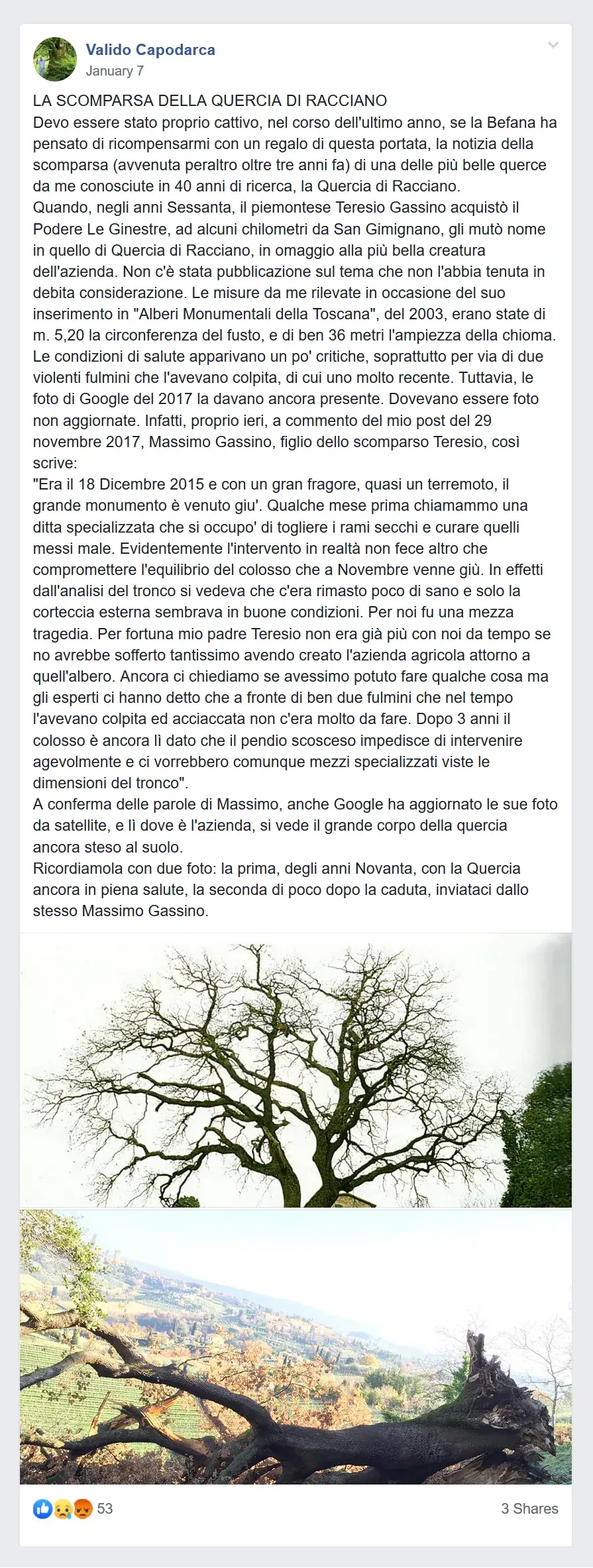
It was 18 December 2015, and with a great roar, almost like an earthquake, the great monument came down. A few months earlier we had called in a specialist company to remove the dry branches and tend to the ones in poor shape. As it turned out, that work only ended up upsetting the giant’s balance, and it came down in November. Looking at the trunk afterwards, you could see there was little healthy wood left, and only the outer bark still seemed to be in decent condition. For us it was something of a tragedy. Luckily my father Teresio was no longer with us by then, or he would have suffered terribly, having built the farm around that tree. We still wonder whether there was anything we could have done, but the experts told us that after being struck and battered by two lightning strikes over the years, there wasn’t much to be done. Three years on, the giant is still lying there, since the steep slope makes it hard to bring equipment in, and specialised machinery would be needed anyway, given the size of the trunk.
Confirming Massimo’s words, Google has also updated its satellite images, and where the farm stands you can see the great body of the oak still lying on the ground.
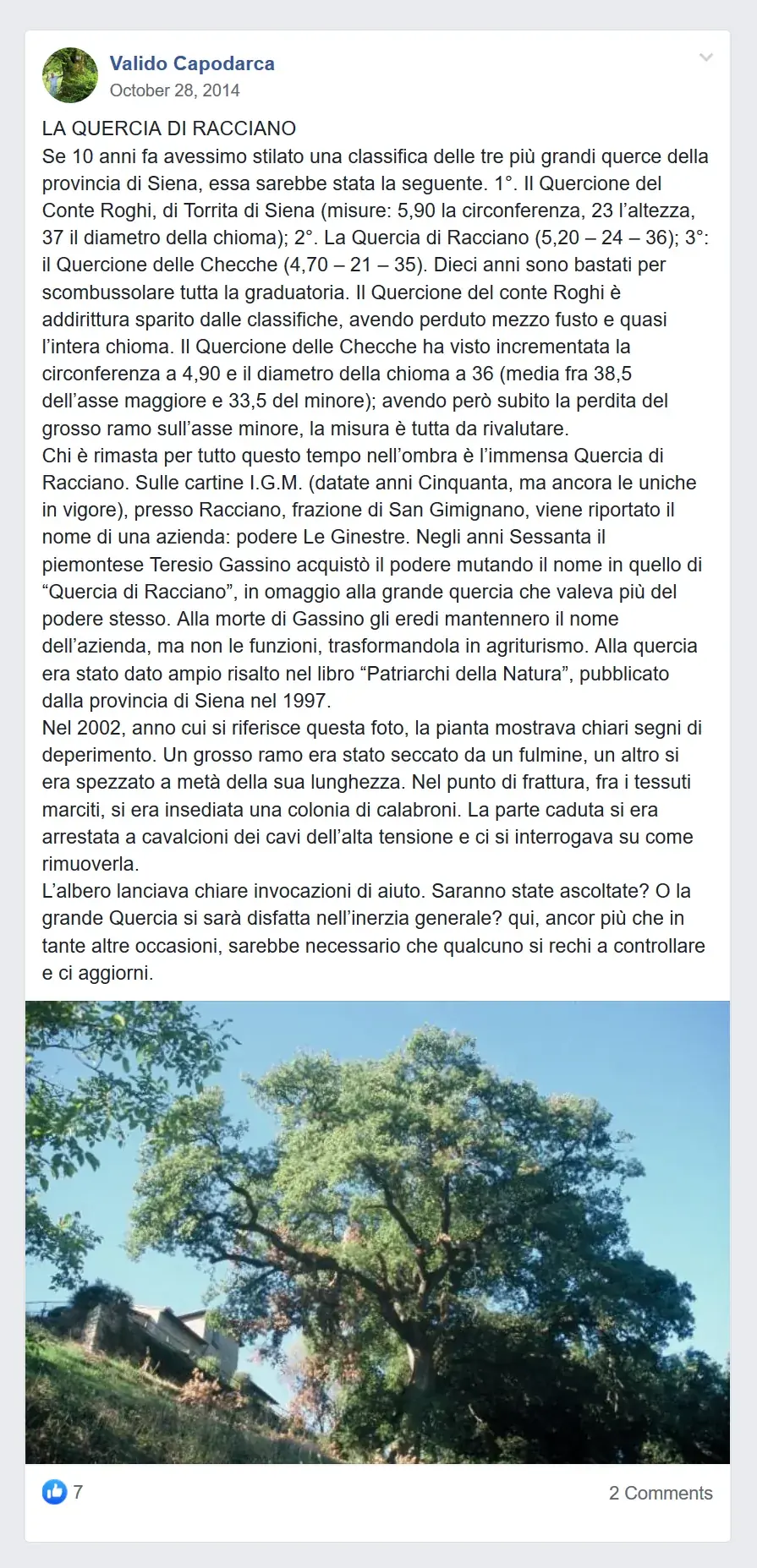
Let’s remember it with two photos: the first, from the 1990s, with the Oak still in full health; the second, taken shortly after it fell, sent to us by Massimo Gassino himself.
Photo 1: a large oak with a majestic tangle of bare branches and no visible canopy. Photo 2: the oak’s felled trunk lying on a grassy slope.